

Why Your CookiePal Page Views Differ from Google Analytics
June 8, 2026
•

2 min read
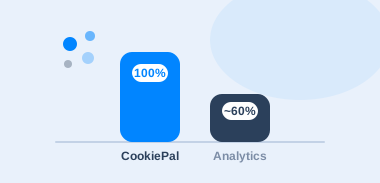
Table of contents
back
to the top
Why Your CookiePal Page Views Differ from Google Analytics
If you’ve compared the page-view count in your CookiePal dashboard against Google Analytics, you’ve probably noticed they don’t match, and that CookiePal’s number is higher.
This is one of the most common questions we get. The short answer is that the two tools measure different things on purpose, so your numbers aren’t wrong.
In this guide, we cover:
- What CookiePal counts as a page view
- How and when page views are counted
- When your count resets and what happens at your limit
- Why CookiePal and Google Analytics show different numbers
What is a page view?
A page view is counted every time someone opens a page on your website where your CookiePal banner is installed. Each time a page is loaded or reloaded, that counts as one page view.
How is a page view counted?
CookiePal records a page view every time a page containing your CookiePal code loads. Whenever a visitor opens, refreshes, or navigates to a page with the banner, it counts as one page view.
The count includes all of your visitors, whether they accept, reject, or ignore your cookie banner.
Are page views counted even if the visitor doesn’t interact with the banner?
Yes. We count every page view, whether or not the visitor clicks or interacts with the cookie banner.
This is intentional. Your banner has to load for every visitor so that everyone gets the chance to make a consent choice, and the page-view count simply reflects how many times that happened.
When does the page-view count reset?
Your page-view count resets at the start of each billing month. You can see your current usage and your plan’s monthly limit at any time in your CookiePal dashboard.
What happens if I reach my page-view limit?
We’ll let you know as you approach your monthly limit so there are no surprises. If you expect more traffic, you can upgrade your plan at any time to raise the limit, and your usage resets at the start of the next billing month.
Why do CookiePal and Google Analytics show different page-view counts?
It’s normal for the page-view number in CookiePal to be higher than the one in Google Analytics (or similar tools), because the two measure different things.
How CookiePal counts. CookiePal counts every page load that includes your CookiePal script. Every visitor is included, whether they accept, reject, or ignore the banner.
How Google Analytics counts. Analytics tools only begin recording page views after a visitor consents to analytics cookies. Visitors who reject the banner, ignore it, or leave before choosing are not included in those reports. Ad blockers and privacy browsers can also stop analytics tools from recording a visit, but they don’t stop your CookiePal banner from loading.
Why they differ. CookiePal counts every page load while analytics tools count only consented visits, so CookiePal will usually report a higher number. This isn’t an error. It reflects each tool’s purpose: CookiePal measures every consent opportunity (every visitor who could see your banner), while analytics tools measure the behavior of visitors who opted in.
Final takeaway
Your CookiePal page views and your Google Analytics page views will rarely match, and they’re not supposed to. CookiePal measures every visitor who could see your banner, while Google Analytics measures the ones who opted in.
Explore further
Shopify Customer Events, Pixels and Cookie Consent
Shopify pixels still collect and send customer data, so they still need consent. Learn how app pixels, custom pixels and the Customer Privacy API should work with your CMP.
October 8, 2026
7 min
WordPress Cookie Consent: Which Plugins and Scripts Need Blocking?
A WordPress banner is not enough if plugins load trackers before consent. Learn which analytics, ad, chat and embed scripts need blocking and how to audit your full stack.
October 8, 2026
7 min
Klaviyo, Shopify and Consent: What E-Commerce Stores Need to Check
Shopify and Klaviyo can track and contact customers in ways they never agreed to. Learn how to align cookie, email and SMS consent across checkout, forms, flows and data sync.
October 1, 2026
7 min